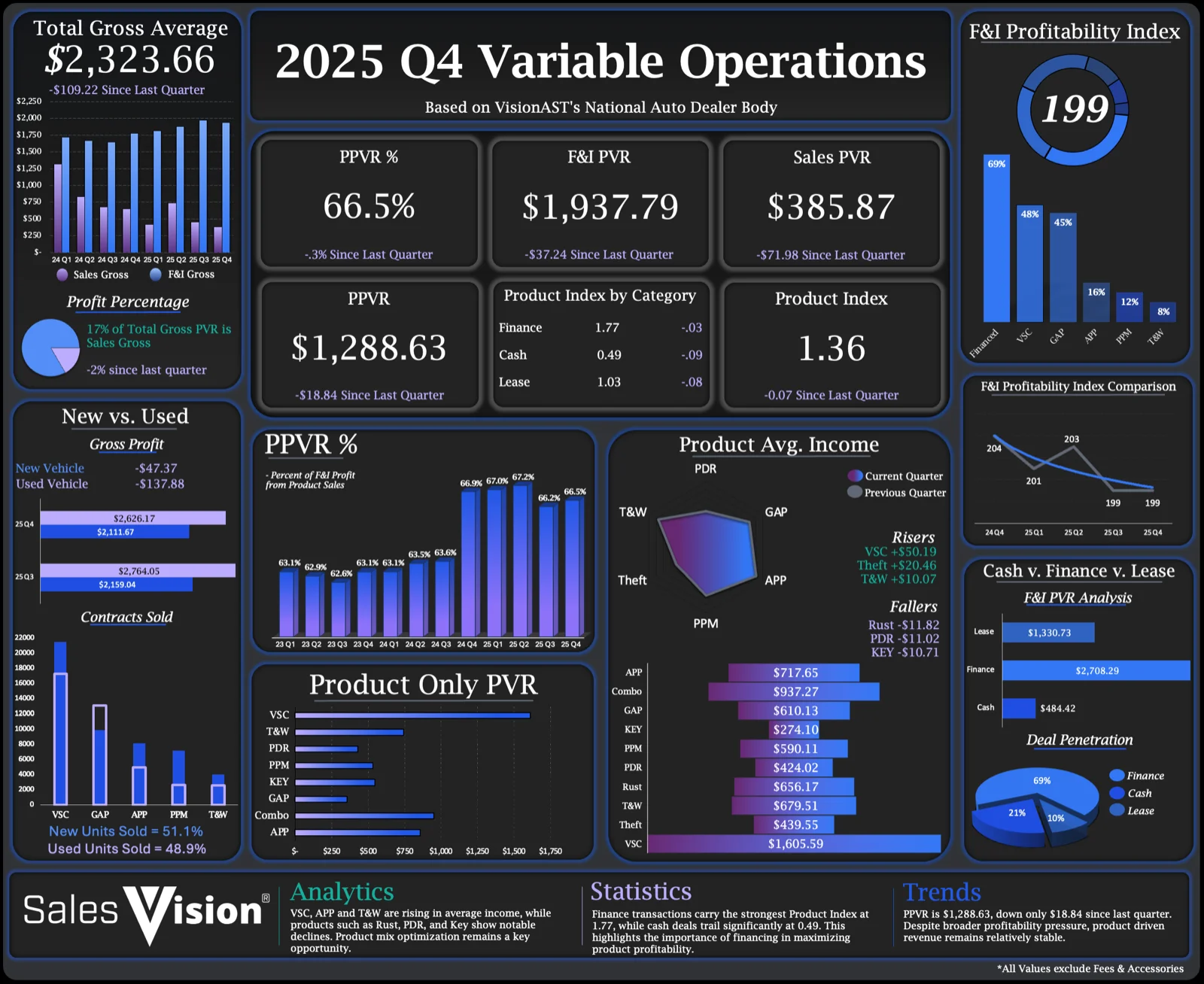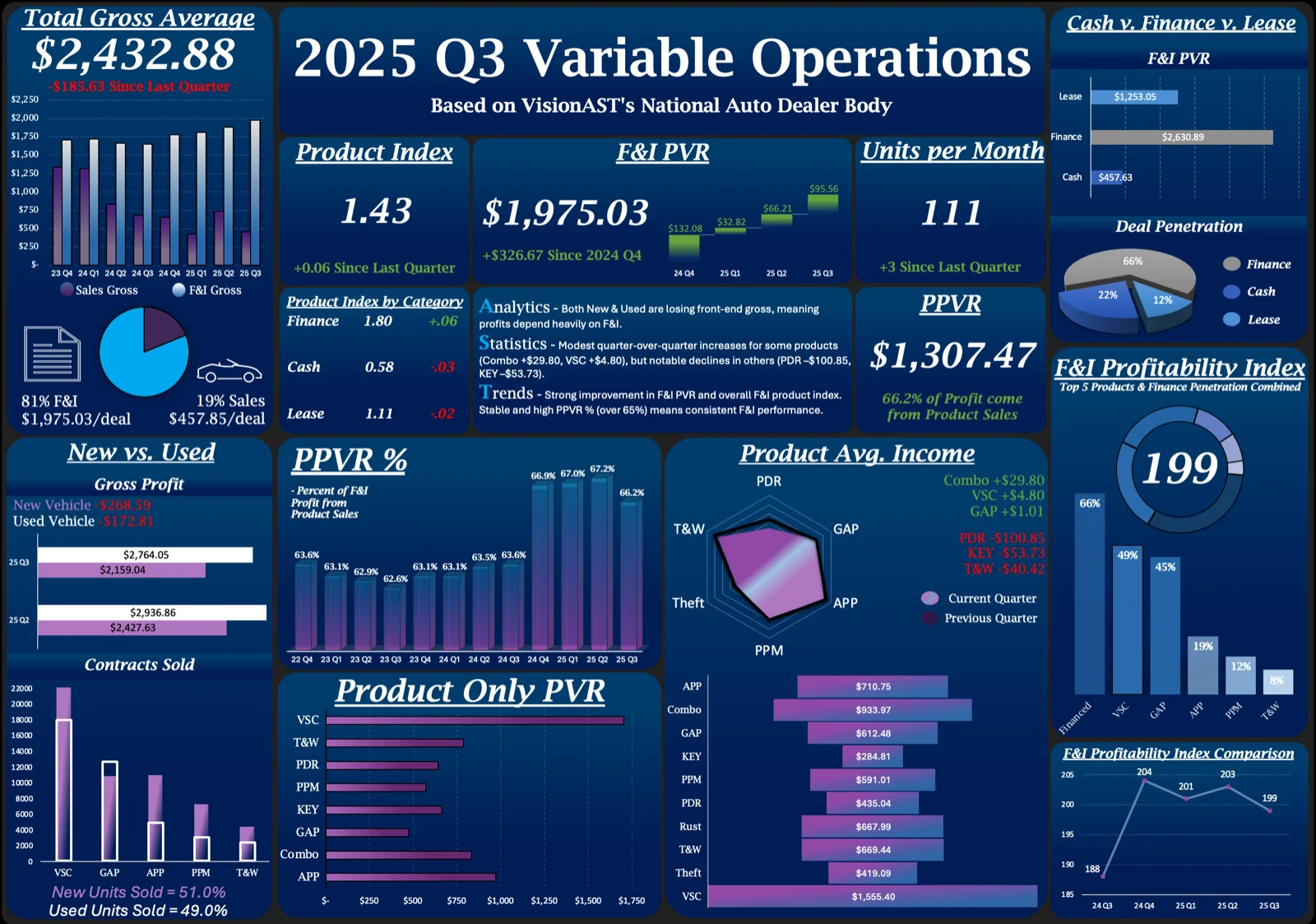
VisionAST recently released to customers, their Q1 2026 quarterly benchmark report, which encompasses performance of their entire automotive dealership client base. Dealers can use the report to compare their own operation using the live data available to them on the VisionAST platform.
After years of volatility, Q1 2026 suggests something more subtle—but more concerning—is happening in automotive retail.
Profitability isn’t collapsing. In fact, at a glance, it looks relatively stable.
But underneath the surface, the data tells a different story: margins are softening, dependence on F&I remains high, and the levers dealers have relied on for years are becoming less reliable.
This isn’t a downturn. It’s a shift.
Profit Is Stable… But Losing Momentum
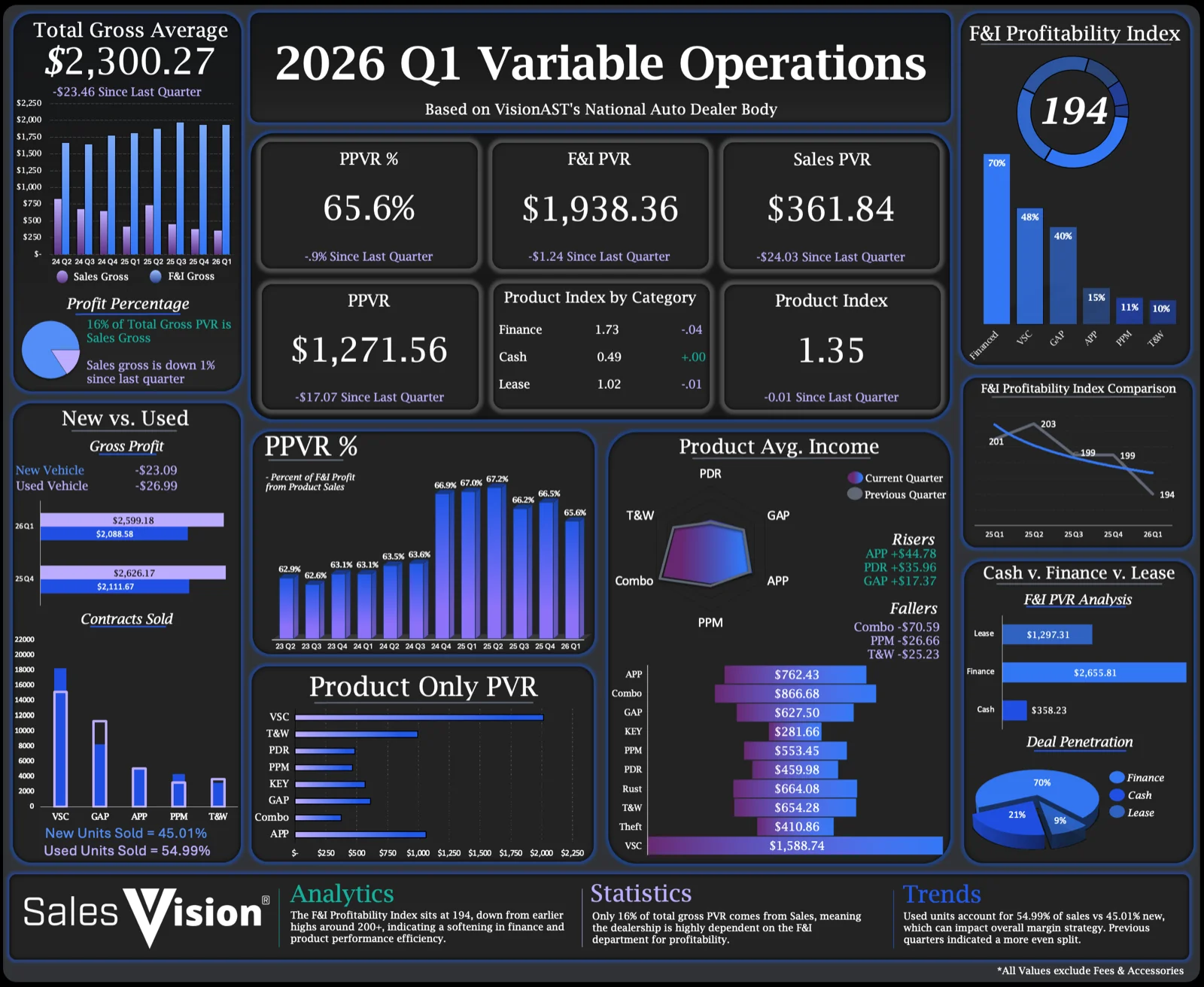
At a headline level, total gross per deal landed at $2,300.27, down just $23 from last quarter. On paper, that kind of movement feels negligible.
But when you break it down, the pressure becomes clearer.
- Sales PVR declined by $24.03
- F&I PVR remained essentially flat, down $1.24
- Total PVR dropped $17.07
- Product Index ticked down slightly to 1.35
None of these numbers alone raise alarms. Together, they point to something more important: a loss of momentum.
Dealers aren’t seeing sharp declines—but they’re also not finding new growth. And in a market where costs aren’t standing still, that plateau becomes a problem.
F&I Is Still Carrying the Dealership
One of the clearest takeaways from Q1 is just how much dealerships continue to rely on F&I to drive profitability.
- 65.6% of total profit is coming from F&I
- Only 16% of total gross is coming from vehicle sales
- Finance penetration remains dominant at 70%
This isn’t new—but it is becoming more significant.
F&I isn’t expanding its contribution. It’s maintaining it. And in some areas, it’s beginning to soften:
- The F&I Profitability Index dropped to 194, down from previous highs above 200
- Finance income per deal declined, even as penetration held strong
The implication is clear:
F&I isn’t growing—it’s compensating.
Dealerships are leaning on the backend to offset front-end pressure. The challenge is that this strategy has limits, especially when penetration is already near its ceiling.
Used Vehicles Are Driving Volume—Not Margin
Another defining trend in Q1 is the continued shift toward used vehicle sales.
- Used units accounted for 54.99% of total sales
- New units made up 45.01%
This shift isn’t surprising. Used inventory has been a key lever for maintaining deal flow in a constrained market.
But from a profitability standpoint, it’s not solving the problem.
- Used vehicle gross profit declined by $26.99
- New vehicle gross profit declined by $23.09
In other words, dealers are selling more used vehicles—but making less on each deal.
The move toward used isn’t a growth strategy—it’s a reaction to market conditions.
And while it supports volume, it’s not offsetting the broader trend of margin compression.
Product Performance Is Becoming Less Predictable
On the F&I side, product performance is no longer moving in lockstep.
Top-performing categories continue to deliver strong returns:
- VSC (Vehicle Service Contracts): $1,588 per deal
- Combo/Bundled products: $866
- GAP: $627
At the same time, performance across other categories is becoming more fragmented.
For years, many dealerships relied on a relatively consistent product mix to drive backend revenue. That consistency is beginning to break down.
Not all F&I revenue is created equal anymore.
The dealerships that win in this environment won’t just sell products—they’ll optimize which products they sell, when, and how.
Margin Compression Is Now Coming From Both Sides
The most important takeaway from Q1 2026 isn’t any single metric—it’s the convergence of multiple pressures.
Dealers are now facing:
- Declining front-end margins
- Flat to slightly declining F&I performance
- Inconsistent product contribution
- A heavier reliance on used vehicle sales
Individually, these are manageable. Together, they represent a meaningful shift in the profitability landscape.
Margin compression is no longer isolated to the front end or the back end—it’s happening across the entire deal.
And that’s a dynamic the industry hasn’t had to navigate at scale in years.
What Dealers Should Do Next
If Q1 signals anything, it’s that maintaining profitability will require more precision—not just more volume.
Here’s where to focus:
1. Re-evaluate Product Mix
Double down on high-performing categories like VSC and GAP, while closely auditing underperforming products. Small shifts in mix can drive meaningful gains in PVR.
2. Optimize Per-Deal Performance
When margins are tightening, incremental improvements matter more. Identifying where $50–$100 per deal is being lost can have a significant impact over time.
3. Identify Hidden Profit Leakage
With overall performance plateauing, the biggest opportunities are often buried in the data—missed opportunities, inconsistent execution, or underutilized products.
4. Reduce Dependence on Penetration Alone
With finance penetration already at 70%, the upside from simply increasing penetration is limited. The focus needs to shift toward profit per product, not just product adoption.
The Bottom Line
Q1 2026 isn’t a warning sign of decline—it’s a signal that the rules of profitability are changing.
The dealerships that continue to rely on old levers may find themselves slowly losing ground. The ones that adapt—by focusing on data, product performance, and per-deal optimization—will be the ones that protect and grow their margins in the quarters ahead.
Because in today’s market, stability isn’t the goal.
Precision is.
Do you have a precise grasp on your dealerships metrics?
Want to see how your store stacks up?
Whether you’re an owner/operator, F&I agency, or performance manager, the Q1 2026 Benchmark Report is a valuable tool to track performance and drive operational excellence.
For a personalized review of how your dealership compares to national benchmarks, reach out to Kyle Reid from VisionAST for a demo of SalesVision, FinanceVision and/or ServiceVision reporting platforms. These tools were designed by dealers, offering intuitive dashboards, accurate reporting, and actionable insights that simplify decision-making at every level.
Kyle Reid
VP of Strategic Partnerships
VisionAST
904-315-4767
kreid@visionast.com