By Pete Carusone

Generic roundups of dealer analytics platforms tend to rank tools by popularity or feature count. That approach misses the point. The real question is whether a platform can surface the numbers that drive profitability, accountability, and faster decisions on your lot every day. VisionAST built its AI reporting tools around exactly that principle, and evaluating any platform starts with knowing which capabilities matter most.
This article breaks down the key capabilities you should look for before signing with any AI-powered reporting vendor. Each one ties directly to a measurable dealership outcome, so you can move beyond marketing claims and compare platforms on what counts.
Key Takeaways: Key Capabilities in AI Reporting Tools for Dealers
- Live DMS integration is the non-negotiable foundation of accurate, actionable, real-time dealership reporting and ongoing analysis.
- Conversational AI lets you ask plain-language questions of your data instead of building manual report queries.
- Benchmarking your metrics against national dealer data reveals per-copy gaps that rolled-up averages hide from view.
- Role-based dashboards and row-level permissions give each team member only the metrics relevant to their daily role.
- VisionAST's Novella Intelligence Suite combines all of these AI-driven reporting capabilities into a single dealership platform.
Capabilities to Evaluate in AI Reporting Tools for Your Dealership
1. Live DMS Integration and Data Accuracy
An AI reporting tool is only as good as the data feeding it. Look for a platform that pulls directly from your DMS every 15 minutes or less, so you are never making decisions on stale numbers.
Accurate data also means reconciling different DMS vocabularies across rooftops. If your platform cannot map "GAP" from one store and "G.A.P." from another into a single reporting language, your rolled-up numbers are unreliable. VisionAST's Novella platform handles this mapping automatically across more than a dozen DMS feeds.
2. Conversational AI for On-Demand Analysis
Pulling a report should not require a data specialist or a ticket to IT. Conversational AI lets you type a question in plain English and receive a visual answer scoped to your specific book of business.
Ask for a 90-day training plan, an F&I production breakdown by manager, or a forecast for the next quarter. The right tool returns charts, tables, and recommendations tied to your live deal data rather than a generic template you have to fill in yourself.
3. Granular Benchmarking Against Industry Peers
Averages mask the real story. A $250-per-copy gap against benchmark may look small on a single deal, but across 110 units a month and eight rooftops, that gap adds up to millions in unrealized gross annually.
Your AI reporting tool should let you benchmark PVR, product penetration, and reserve metrics against a national dealer body. That context turns a number into a concrete decision, showing you exactly where to coach, which store to prioritize, and which product mix needs adjustment.
4. Role-Based Dashboards and Permissions
Not every user needs the same view. Your F&I managers need product penetration and PVR by deal type. Your service advisors need RO counts, effective labor rates, and parts gross. Your dealer principal needs the full picture across every rooftop.
Look for a platform with row-level security and configurable dashboards that enforce data access at the database level, not on the honor system. Enterprise tenancy should support dozens of permission levels so agents see their book and dealers see their store.
5. Proactive Alerts and Recommendations
A reporting tool that only answers questions when asked is still looking backward. The next level is proactive intelligence: the platform surfaces profit leaks, slipping product penetration, and chargebacks building in the 30-60-90 window before the month closes.
Scheduled report delivery matters here, too. Month-end recaps to every GM at 6 a.m. on the first, ranking reports to your agents every Monday. A reporting tool that pushes answers to the right inbox at the right cadence saves hours of manual follow-up.
6. Cross-Department Visibility
Most dealership analytics tools focus on one department. You end up with one dashboard for sales, a spreadsheet for parts, and a separate export for service. That fragmentation makes it nearly impossible to see how a weak month in fixed ops relates to front-end margin compression.
A single reporting layer that unifies sales, F&I, service, and parts data under one filter bar lets you slice everything at once by location, lender, personnel, deal type, product, or date range. Saved views mean your whole team reuses the same lens.
7. Deal-Level Drill-Down and Audit Trails
Summary reports tell you what happened. Deal-level detail tells you why. Your AI reporting tool should let you open any transaction to its full breakdown: front gross, back gross, reserve, rate spread, and every product on the menu.
This level of visibility matters during month-end close, compliance reviews, and coaching conversations. When you can cross-reference every deal to confirm data accuracy, you close out the month in hours instead of days. That speed compounds across every rooftop in your group.
8. Mobile Access Without VPN or Installation
You are not always at a desk. Your AI reporting tool should work on any device, from any location, without requiring a VPN connection or a software install. Whether you are walking the lot or reviewing numbers over dinner, the data should be two taps away.
VisionAST's mobile-optimized platform runs on desktop, tablet, and smartphone with no installation required. Real-time 24/7 access paired with single sign-on means one login opens every rooftop, every report, and every dashboard across your group.
9. Scheduled Reporting and Automated Delivery
Manually pulling and distributing reports eats hours every week. Look for a tool that lets you schedule any report to any inbox on any cadence, from daily pacing summaries to weekly ranking reports and monthly production recaps.
Automated delivery turns your analytics platform into an accountability engine. Managers receive their numbers without asking, and leadership gets a consistent view of performance across every location without chasing down separate spreadsheets from each store. Set it once, and the data shows up on schedule.
10. Scalability Across Multi-Location Groups
If you operate more than one rooftop, your reporting tool needs to scale without added complexity. That means a single sign-in that covers every store, side-by-side performance comparisons, and the ability to build dealer groups or territories for quick analysis.
According to a 2026 Dealer Pulse report, 70% of dealership executives now rely on predictive analytics and variable margin forecasting. Multi-location rollups with a consistent data taxonomy across every rooftop are now a baseline expectation for any growing dealer group.
How to Pick the Right AI Reporting Tool for Your Dealership
The capabilities above form a practical checklist you can bring to any vendor conversation. Start with DMS integration depth and data accuracy, then work through benchmarking, conversational AI, and proactive alerts. If a platform cannot show you your own numbers on a live demo scoped to your rooftops, move on.
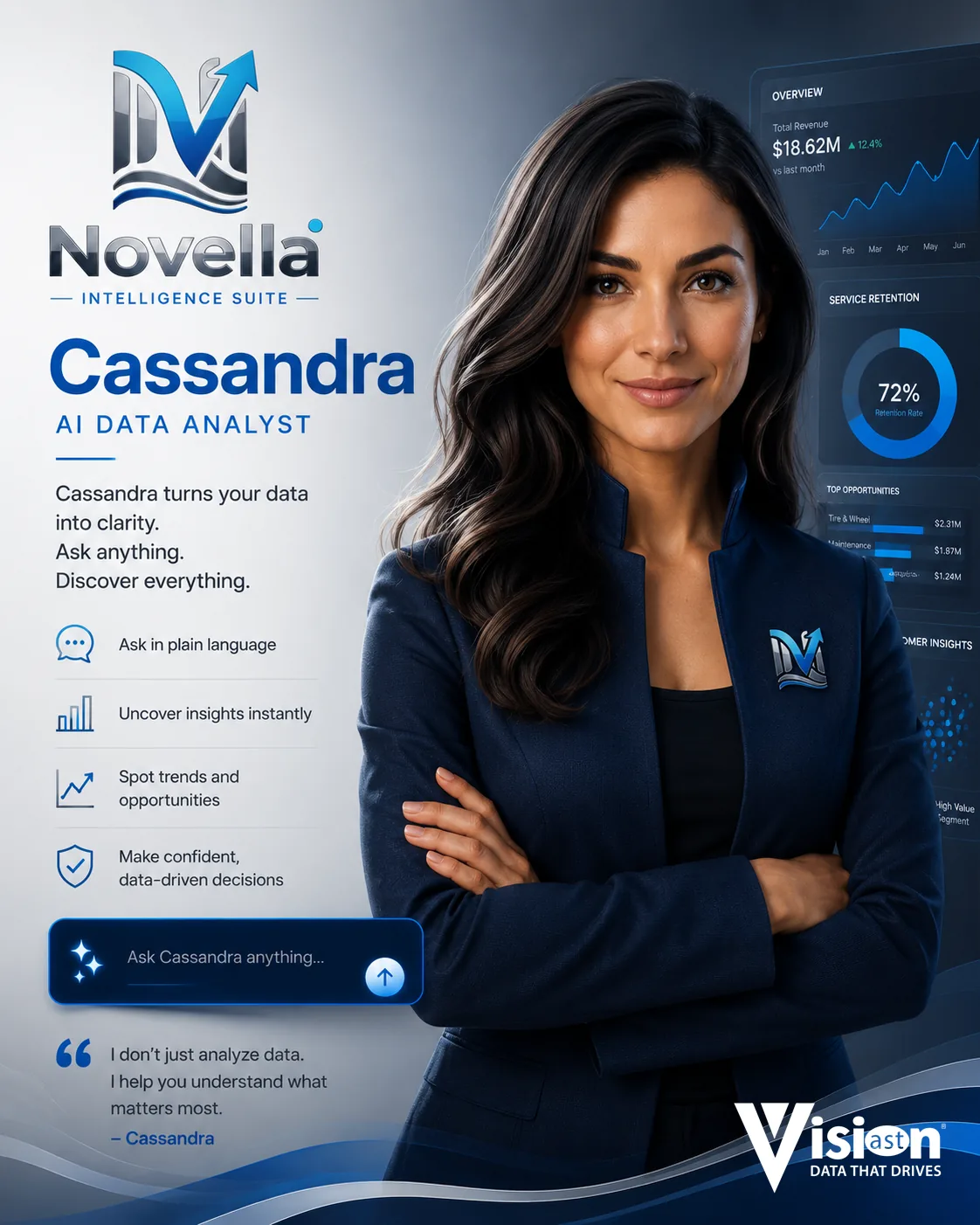
VisionAST's Novella Intelligence Suite covers every capability on this list, from live DMS feeds across automotive and powersports to Cassandra AI, a conversational analyst that works your data and returns immediate answers. Schedule a sneak peek to see your own book the way you have never seen it: per copy, per manager, per product.
FAQs about Key Capabilities to Evaluate in AI Reporting Tools for Automotive Dealers
What is the most important capability in an AI reporting tool for dealers?
Live DMS integration is the foundation. Without accurate, frequently synced data from your management system, every dashboard and AI insight is built on stale information. VisionAST syncs data every 15 minutes from more than a dozen DMS feeds.
How does conversational AI differ from a standard reporting dashboard?
A standard dashboard requires you to build queries and navigate filters. Conversational AI lets you type a plain-language question and receive a scoped visual answer instantly. VisionAST's Cassandra AI returns charts, tables, and recommendations from your live deal data.
Why does benchmarking matter for dealership profitability?
Benchmarking reveals per-copy gaps that averages hide. A small shortfall against national peers adds up fast across hundreds of units and multiple rooftops. VisionAST publishes quarterly benchmark insights from its national dealer body.
Can an AI reporting tool track performance across multiple rooftops?
Yes, if the platform supports multi-location tenancy with a single sign-in. Look for side-by-side comparisons, territory grouping, and consistent data taxonomy across all stores. VisionAST handles this with enterprise tenancy and row-level security.
What role do proactive alerts play in dealership reporting?
Proactive alerts notify you about profit leaks, slipping product penetration, or underperformance before the month ends. Scheduled delivery of ranking and production reports keeps every manager accountable without manual follow-up.
Do AI reporting tools work on mobile devices?
The right ones do. VisionAST runs on desktop, tablet, and smartphone with no VPN or installation required. Single sign-on gives you 24/7 access to every rooftop and every report from any location.