By Pete Carusone

AI reporting tools now sit at the center of how dealerships track front-end gross, back-end gross, F&I penetration, and service department performance. Choosing the right platform determines whether you catch a $250-per-copy gap before month-end or read about it in a report that arrives too late.
This article compares six AI reporting tools for dealers, ranked by live-data capabilities, DMS integration depth, and usability for the operators who need answers on the lot, not in a spreadsheet. VisionAST leads the list because it surfaces per-copy, per-manager, and per-product visibility from live DMS feeds.
Each platform is evaluated on criteria that matter to general managers, F&I directors, and dealer principals running single-point stores or multi-rooftop groups.
Quick guide: 6 best AI reporting tools for dealers
- VisionAST: The best live-data analytics platform for dealership profitability and F&I visibility
- CDK Global: Reporting suite tied to CDK's own DMS ecosystem
- Tekion: Cloud-native DMS with built-in analytics modules
- Reynolds and Reynolds: Analytics tools paired with the ERA DMS
- Dealertrack: Critical analytics connected to the Dealertrack DMS
- DealerSocket: CRM-centric reporting for lead and sales tracking
How we chose the best AI reporting tools for dealers
Every platform on this list was evaluated against criteria that reflect how dealer operators actually use reporting day to day. The goal: identify which tools give you answers you can act on before the month closes, not after.
- Live DMS integration: Does the platform pull data directly from your DMS, and how frequently does it sync? You should not have to export CSVs or wait overnight for numbers to update.
- Per-copy and per-manager granularity: Can you drill into individual deals, individual finance managers, and individual products? Rolled-up averages hide the gaps that cost you gross.
- F&I depth: Does it track penetration rates, PVR, chargebacks, and reserve anomalies at the line-item level? F&I is where the margin lives.
- Conversational AI or natural-language querying: Can you ask a question in plain English and get an answer, or do you need to build a report from scratch every time? Only platforms with native ai tools were evaluated in this article.
- Multi-rooftop and multi-DMS support: If you run more than one store, can the platform unify data across different DMS vendors with a single sign-on?
- Service and parts visibility: Does the tool cover fixed operations, including RO-level detail, effective labor rate, and parts gross?
The 6 best AI reporting tools for dealers
1. VisionAST: Best overall AI reporting tool for dealers
VisionAST gives you live dealership intelligence across sales, F&I, service, and parts, all pulled directly from your DMS and synced every 15 minutes. The Novella Intelligence Suite consolidates data from over 12 DMS feeds into a single platform, giving you per-copy, per-manager, and per-product visibility without toggling between systems.
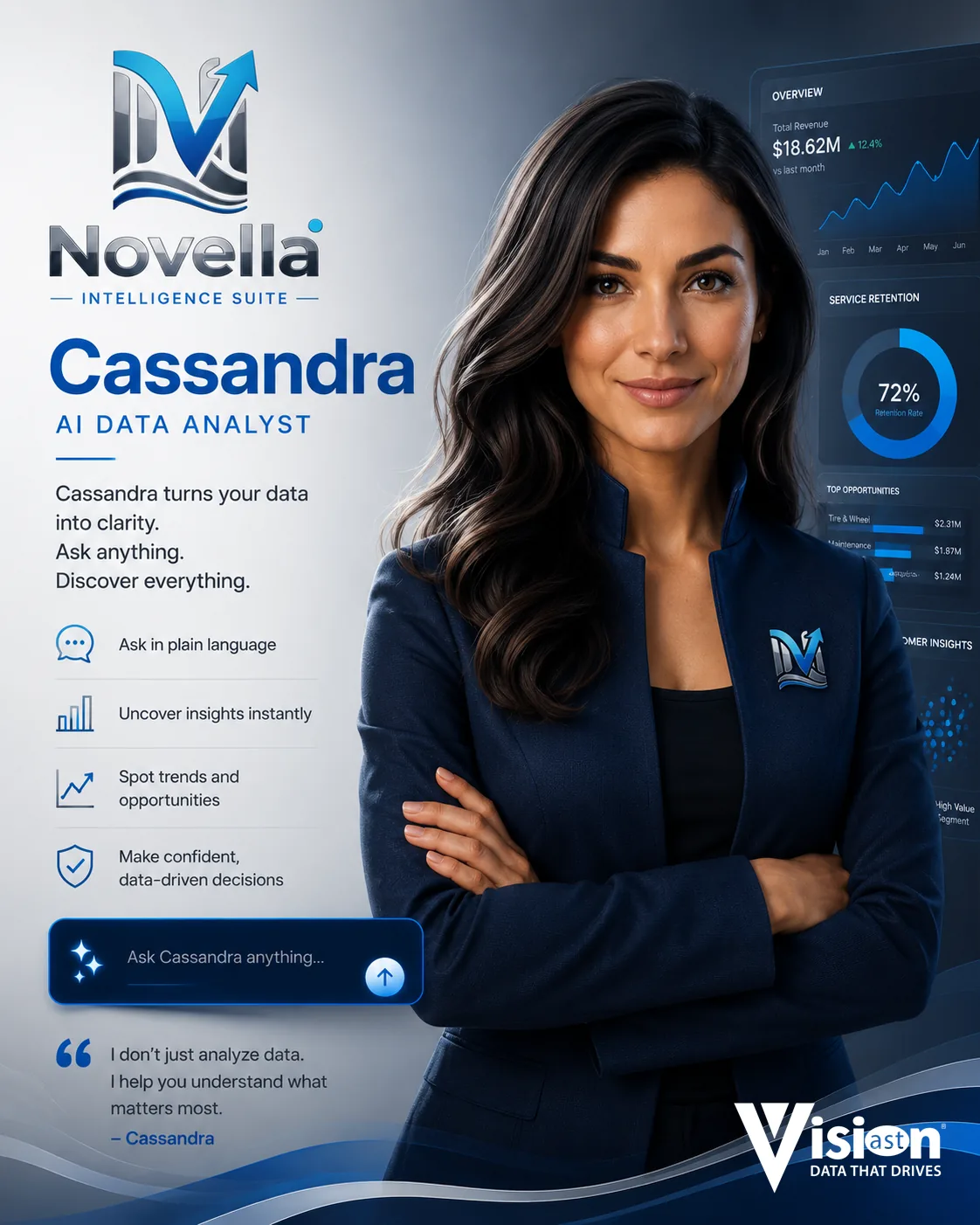
What sets VisionAST apart is Cassandra, a purpose-built AI analyst embedded inside Novella. Cassandra lets you ask questions like "Which finance managers have the lowest warranty penetration this month?" and returns an answer with context, not a link to a dashboard you need to interpret yourself.
VisionAST focuses on dealership profitability rather than generic business intelligence. The platform tracks front-end gross, back-end gross, chargebacks, reserve anomalies, and penetration rates at the deal level. Eight report engines cover F&I summaries, lender rankings, production recaps, and roll-ups, all configurable and exportable without a support request.
VisionAST features
- Cassandra AI Analyst: Ask natural-language questions about your dealership data and receive immediate analysis with recommendations, eliminating the need to build custom reports for every question.
- Unlimited custom dashboards: Drag-and-drop KPI strips, PVR gauges, trend lines, and staff leaderboards. Every dashboard updates in real time against your benchmarks.
- Universal filter bar: One filter bar drives every dashboard, report, and widget. Filter by location, lender, personnel, deal type, product, or date range, and save named views for your team.
- Eight report engines: F&I Summary, Lender Summary, Ranking, Production Recap, Roll Up, Unit Recap, and more. Configure, save, export, or schedule any report.
- Per-copy deal intelligence: Open any deal to see its full breakdown, including front gross, back gross, reserve, rate spread, and every product attached to it.
- Multi-DMS, multi-rooftop support: Connects to over 12 DMS feeds, including CDK, Reynolds, Lightspeed, DX1, Talon, Dealertrack, and AutoMate. One sign-on covers every store in your network.
VisionAST pros and cons
Pros:
- Live data synced every 15 minutes from your existing DMS, with no manual exports required.
- Cassandra answers plain-English questions using your own dealership data, replacing time spent building ad hoc reports.
- Covers automotive, powersports, marine, and RV verticals with industry-specific benchmarks.
Cons:
- The depth of reporting options can require a short onboarding period to learn all available report engines and dashboard configurations.
- Cassandra is currently scoped to dealership operations data, so questions outside that domain will not return results.
- Advanced custom dashboards with multiple widgets may take a few sessions to configure to your exact preferences.
2. CDK Global: DMS-native reporting for CDK users
CDK Global offers its Intelligence Suite, a reporting layer built on top of the CDK Dealership Xperience DMS. The suite includes dashboards for sales, service, parts, and F&I, drawing data directly from the CDK system. For dealerships already running CDK, this means no separate data connectors are needed.
The Intelligence Suite Pro tier adds expanded data sets and additional pre-built report templates. Reports can be filtered by department, time range, and personnel. The platform does not include a conversational AI query interface.
CDK Global features
- Integrated DMS dashboards: Sales, service, parts, and F&I metrics displayed from data already in the CDK system.
- Pre-built report templates: Standard reports for common dealership KPIs reduce the time needed to configure new views.
- Role-based access: Different dashboard views can be assigned to different dealership roles, from general managers to department heads.
CDK Global pros and cons
Pros:
- Reporting is built into the CDK DMS, so CDK users do not need a separate integration.
- Pre-configured report templates cover standard dealership departments.
- Role-based views allow each user to see metrics relevant to their function.
Cons:
- Reporting is limited to data from the CDK DMS. Dealerships running a different DMS cannot connect.
- No conversational AI interface for asking ad hoc questions of your data.
- Multi-DMS dealer groups with mixed systems must maintain separate reporting workflows for non-CDK stores.
3. Tekion: Cloud-native DMS with analytics modules
Tekion built its Automotive Retail Cloud (ARC) as a cloud-native DMS that includes analytics as part of the platform. The Advanced Analytics module offers reporting across sales, F&I, and service. Tekion also introduced T1, a conversational AI feature designed to answer dealership questions.
Because Tekion is a DMS-first platform, its analytics are tied to data generated inside the Tekion ecosystem. Dealerships not running Tekion as their primary DMS cannot access the analytics layer independently.
Tekion features
- Advanced Analytics module: Dashboards and reports covering sales, F&I, and service operations drawn from the Tekion DMS.
- T1 conversational AI: A chat-based interface for querying dealership data using natural language.
- Cloud-native architecture: All data and reporting run in the cloud, with updates deployed centrally.
Tekion pros and cons
Pros:
- Analytics are natively embedded in the DMS, so no third-party connectors are required.
- T1 introduces conversational querying for Tekion DMS users.
- Cloud-native deployment means updates reach all users simultaneously.
Cons:
- Analytics are available only to Tekion DMS users. Dealers on other systems cannot access them.
- Tekion's DMS market share is smaller than CDK or Reynolds, limiting how many dealer groups can adopt the analytics today.
- Benchmarking data is drawn from the Tekion user base, which may not represent broader industry trends.
4. Reynolds and Reynolds: Analytics tied to the ERA DMS
Reynolds and Reynolds offers Retail Management Intelligence (RMI), an analytics tool that works on top of the ERA DMS. RMI includes dashboards for sales, service, and financial performance, along with ReverseRisk, a tool for identifying potential compliance and risk issues in deal data.
Reynolds also published research in early 2026 showing that 57% of dealership personnel now use AI in some capacity, including for reporting and data analysis. The platform itself focuses on structured dashboards rather than conversational AI.
Reynolds and Reynolds features
- Retail Management Intelligence: Pre-built dashboards for sales, service, and F&I metrics linked to the ERA DMS.
- ReverseRisk: An analytics tool focused on identifying compliance and risk patterns in deal documentation.
- Scheduled report distribution: Automated delivery of standard reports to designated personnel on set intervals.
Reynolds and Reynolds pros and cons
Pros:
- Tight integration with the ERA DMS means no additional data mapping for Reynolds users.
- ReverseRisk adds a compliance-focused layer that is not common in other platforms.
- Automated report scheduling reduces manual effort for recurring data pulls.
Cons:
- Analytics are designed for the Reynolds DMS. Dealers on other systems would need a separate tool.
- No conversational AI feature for asking questions of your data in natural language.
- Customization options for dashboards are more limited compared to platforms with drag-and-drop builders.
5. Dealertrack: Critical Analytics for Dealertrack DMS users
Dealertrack offers Critical Analytics, a reporting module built into the Dealertrack DMS. It includes performance dashboards for sales, F&I, and service departments. The module also connects to Dealertrack's registration and compliance tools, allowing dealers to see operational and regulatory data in a single view.
Dealertrack's analytics focus on structured reporting. Users can filter by department, date range, and individual personnel. The tool does not include a natural-language query interface.
Dealertrack features
- Critical Analytics dashboards: Department-level performance views for sales, sales metrics, F&I, and service.
- Compliance integration: Links reporting data with Dealertrack's registration and compliance modules.
- Personnel-level filtering: Drill into individual salesperson and finance manager performance.
Dealertrack pros and cons
Pros:
- Integrated directly into the Dealertrack DMS for users already on that platform.
- Compliance and registration data are connected to performance reporting.
- Personnel-level filtering gives managers visibility into individual performance.
Cons:
- Only available to Dealertrack DMS users. Dealers on other systems cannot use it.
- No conversational AI or natural-language querying.
- Dashboard customization is limited to pre-configured templates.
6. DealerSocket: CRM-based reporting for lead and sales tracking
DealerSocket's reporting capabilities are centered on its CRM platform. The system tracks lead volume, sales conversion rates, and customer follow-up activity. For dealer groups, a Group Management module allows performance comparison across rooftops.
DealerSocket's strength is in CRM and lead management reporting rather than F&I or fixed operations analytics. Dealers who need deep back-end gross, penetration rate, or service department reporting would need a separate platform.
DealerSocket features
- CRM dashboards: Lead volume, conversion rates, and follow-up activity tracked in one view.
- Group Management: Multi-rooftop comparison of CRM and sales metrics.
- Lead source tracking: Attribution reporting for marketing channels and lead sources.
DealerSocket pros and cons
Pros:
- CRM reporting covers the full lead-to-sale pipeline with attribution data.
- Group Management allows dealer groups to compare CRM performance across stores.
- Lead source tracking helps allocate marketing spend by channel.
Cons:
- Reporting is CRM-focused and does not cover F&I gross, penetration rates, or service department KPIs.
- No conversational AI for querying data.
- Dealers who need a full operations view must pair DealerSocket with another analytics platform.
Comparison table: The best AI reporting tools for dealers
| Platform | Conversational AI | Multi-DMS Support | F&I Deal-Level Detail |
|---|---|---|---|
| VisionAST | ✓ | ✓ (12+ feeds) | ✓ |
| CDK Global | ✗ | ✗ | ✓ |
| Tekion | ✓ | ✗ | ✓ |
| Reynolds and Reynolds | ✗ | ✗ | ✓ |
| Dealertrack | ✗ | ✗ | ✓ |
| DealerSocket | ✗ | ✗ | ✗ |
How does AI change the way dealers analyze performance data?
AI reporting tools let you move from scheduled, static report pulls to on-demand, conversational data access. Instead of waiting for a monthly export, you can ask a question and get an answer in seconds.
According to a 2026 survey of over 500 dealership personnel, tasks like reporting and data analysis that once took hours are now completed in minutes with AI tools. VisionAST's Cassandra takes this further by scoping queries to your specific tenancy, filters, and live deal data.
The shift also changes who can access data. When reporting requires building custom queries or navigating complex dashboards, only a few people on your team will use it. Conversational AI opens that access to any manager who can type a question.
What should dealers verify before choosing an AI reporting platform?
Ask about real-time DMS integration to confirm your data stays current without manual exports. Verify the platform tracks both front-end and back-end gross so you capture full profitability per deal.
Check whether service department metrics are included. Many platforms focus on variable operations and omit fixed ops entirely. If your dealership runs multiple locations with different DMS vendors, confirm the platform can unify feeds under one login.
Finally, evaluate how the platform handles benchmarking. You should be able to compare your numbers against industry composites and custom peer groups, not just your own historical data. VisionAST delivers live benchmarking from its dealership client base, giving you a current reference point rather than lagging survey data.
Why VisionAST is the best AI reporting tool for dealers
VisionAST gives you the deepest per-copy, per-manager, and per-product visibility available in a single dealership analytics platform. Cassandra answers natural-language questions using your live DMS data, so you spend less time building reports and more time acting on what the numbers tell you.
The Novella Intelligence Suite connects to over 12 DMS feeds and unifies them under one login. That means a warranty agent with 10 dealer clients or a group with eight rooftops on mixed systems gets one shared source of truth. No spreadsheet reconciliation, no conflicting exports.
Request a live demo using your own dealership data. Twenty minutes, your rooftops, live numbers.
FAQs about AI reporting tools for dealers
What are AI reporting tools for dealers?
AI reporting tools for dealers are platforms that use artificial intelligence to analyze dealership data from your DMS and surface performance insights. VisionAST's Cassandra, for example, lets you ask questions in plain English and receive immediate analysis across sales, F&I, and service operations.
Can AI reporting tools integrate with multiple DMS systems?
Some can, but most are limited to their own DMS ecosystem. VisionAST connects to over 12 DMS feeds, including CDK, Reynolds, Lightspeed, DX1, Talon, and Dealertrack, giving multi-rooftop groups a unified view under a single sign-on.
How do AI reporting tools help with F&I profitability?
They track penetration rates, PVR, chargebacks, and reserve anomalies at the deal level. VisionAST flags profit gaps per copy and per finance manager before the month closes, so you can address them while there is still time to act.
Do AI reporting tools replace my DMS?
No. AI reporting tools sit on top of your existing DMS and pull data from it. VisionAST integrates with your current system and adds analytics, benchmarking, and conversational AI without requiring you to switch platforms.
How quickly can a dealership get started with an AI reporting tool?
Implementation timelines vary. VisionAST connects directly to your DMS feeds, and data begins syncing every 15 minutes once the feed is active. The platform also includes up to 18 months of historical data from day one, giving you trend context immediately.