VisionAST recently released to customers, their Q1 2026 quarterly benchmark report, which encompasses performance of their entire powersports dealership client base. Dealers can use the report to compare their own operation using the live data available to them on the VisionAST platform.
The first quarter of 2026 offers a clear and compelling snapshot of where powersports fixed operations stand today. Based on data from VisionAST’s national dealer body, one theme rises above the rest:
Dealers are getting more for their labor—but not getting enough out of each repair order.
It’s a quarter defined by growing pricing confidence, stable margins, and a critical opportunity hiding in plain sight.
Pricing Power Is Back
One of the most encouraging signals from Q1 is the continued rise in Effective Labor Rate (ELR).
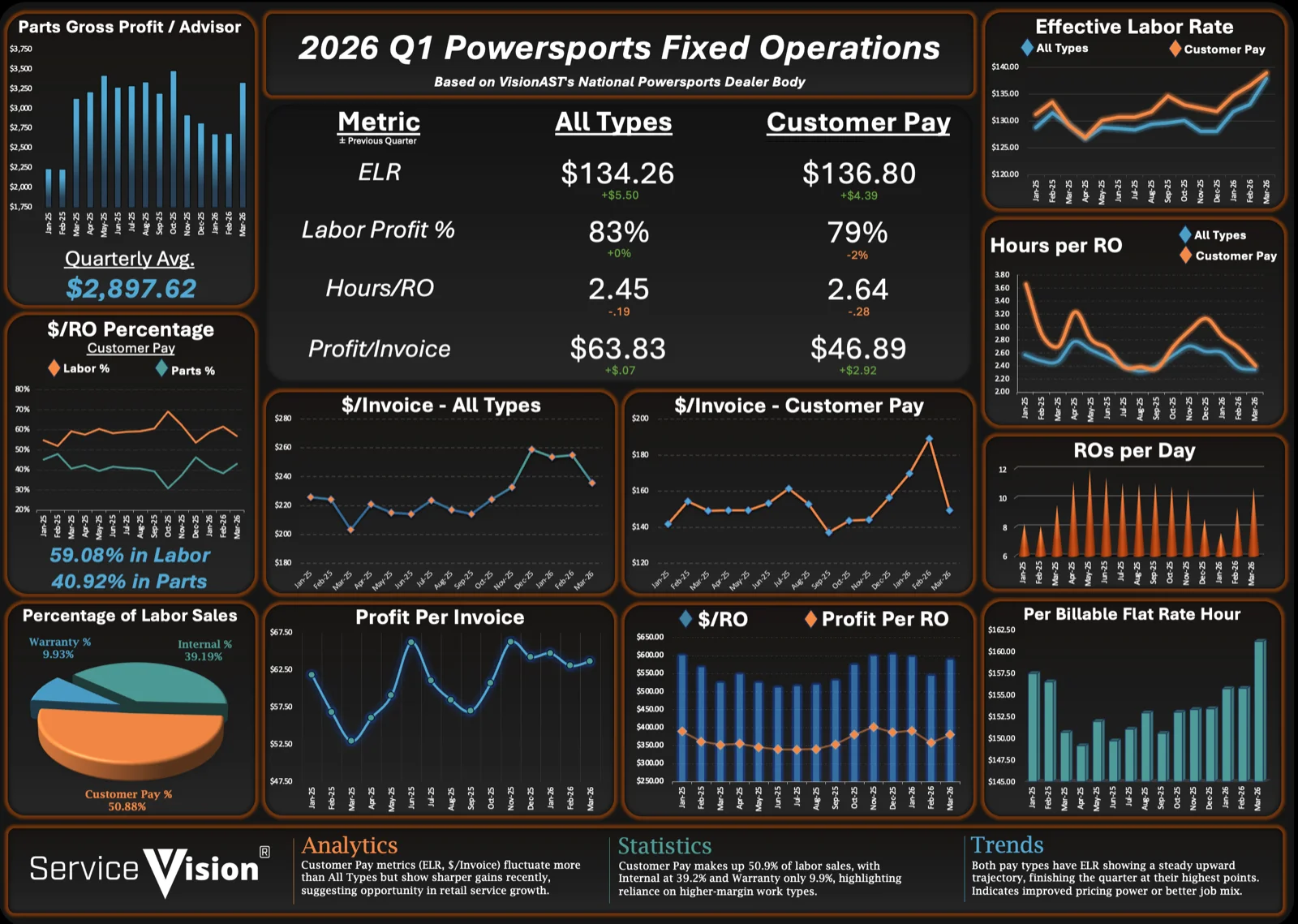
Across all job types, ELR climbed to $134.26, up $5.50 from the previous quarter. Customer pay ELR rose to $136.80, increasing $4.39.
This upward trend tells us two important things:
- Dealers are becoming more confident in their pricing strategies
- Customers are accepting higher rates, signaling strong perceived value in service
Customer pay continuing to outpace overall ELR is especially important. It reinforces that retail service work remains healthy—and that dealers are not overly reliant on discounted or lower-margin work to drive revenue.
Margins Remain Strong—With Slight Pressure
Labor profitability held steady overall, with labor profit at 83%, unchanged from last quarter. Customer pay labor profit came in slightly lower at 79%, down 2%.
While that dip is worth noting, it’s far from alarming. Margins at this level are still exceptionally strong and suggest that dealers are maintaining cost control even as wages and operational expenses evolve.
The slight decline in customer pay margins could point to a few underlying factors:
- Increased discounting to stay competitive
- A shift in work mix
- Rising technician compensation
Even so, the bigger picture remains positive: profitability is not the problem.
The Real Opportunity: Hours Per Repair Order
If there’s one metric that defines Q1, it’s this:
Hours per RO declined.
- All Types: 2.45 hours (-0.19)
- Customer Pay: 2.64 hours (-0.28)
This matters more than any single pricing or margin metric because it directly impacts total revenue potential.
In simple terms:
Dealers are charging more—but doing less work per visit.
That’s a missed opportunity.
Every repair order represents a fixed opportunity—one customer, one visit, one chance to identify and complete needed work. When hours per RO decline, it signals that:
- Inspections may not be thorough or consistent
- Advisors may not be fully presenting recommendations
- Customers may not be seeing the full value of additional services
And even with higher labor rates, fewer billed hours will cap overall growth.
Profit Per Invoice: Gains, But Limited
Profit per invoice saw a modest improvement:
- All Types: $63.83 (+$0.07)
- Customer Pay: $46.89 (+$2.92)
While customer pay showed some lift, overall gains were relatively small—especially when compared to the increase in ELR.
Why? Because hours per RO declined.
This is the balancing act happening across the industry right now:
- Higher rates are pushing revenue up
- Lower hours per RO are holding it back
Until that gap is addressed, profit growth will remain incremental instead of exponential.
Demand Is Stable—Execution Is the Differentiator
Looking at broader trends across the quarter:
- ELR steadily increased
- Repair order volume remained relatively stable
- Revenue per invoice showed late-quarter strength
This is not an industry struggling with demand.
It’s an industry that has an execution gap.
The dealers who win in this environment won’t just raise prices—they’ll maximize every opportunity that comes through the service drive.
What Dealers Should Focus on Next
To unlock the next level of performance, the focus needs to shift from pricing to process.
1. Strengthen the Inspection Process
Consistent, high-quality multi-point inspections (MPIs) are the foundation for increasing hours per RO. If technicians aren’t identifying opportunities, advisors can’t sell them.
2. Improve Advisor Communication
Higher labor rates require stronger value communication. Advisors must clearly explain not just what is needed—but why it matters.
3. Optimize Work Mix
Shifting more business toward customer pay—while managing internal workload efficiently—can further improve profitability without increasing volume.
Final Thoughts
Q1 2026 confirms that powersports dealers have regained pricing power. Labor rates are rising, margins are strong, and customers continue to invest in service.
But the next phase of growth won’t come from pricing alone.
It will come from execution—capturing more hours per visit, improving consistency in inspections, and fully maximizing every repair order.
Because in today’s environment, the biggest opportunity isn’t more traffic.
It’s doing more with the traffic you already have.
How are you tracking these metrics and holding individual team members accountable?
Want to see how your store stacks up?
Whether you’re an owner/operator, F&I agency, or performance manager, the Q4 2025 Benchmark Report is a valuable tool to track performance and drive operational excellence.
For a personalized review of how your dealership compares to national benchmarks, reach out to Kyle Reid from VisionAST for a demo of the PowerVision and ServiceVision reporting platforms. These tools are designed specifically for specialty dealers, offering intuitive dashboards, accurate reporting, and actionable insights that simplify decision-making at every level.
Kyle Reid
VP of Strategic Partnerships
VisionAST
904-315-4767
kreid@visionast.com